Showing posts sorted by relevance for query newmarket. Sort by date Show all posts

Friday, March 11, 2016

Newmarket Gold - Additional Comments

This article is a continuation of the yesterday published post on Newmarket Gold.

Impairments

Although in 2015 Newmarket Gold made higher profit from mining operations ($60.6 million versus $41.3 million in 2014), the company printed a net loss of $2.8 million (in 2014 Newmarket made net income of $20.0). Let me comment on this issue.

In its 2015 report the company stated (page 25):

"At December 31, 2015, the discounted cash flows over the life of mine for Cosmo was below the carrying value of the long-lived assets of the mine and as a result an impairment of $24,073 was recorded against mine properties and $1,424 recorded against property, plant, and equipment (Note 16), resulting in a total impairment charged to the statement of operations of $25,497"

This impairment charge accounted for the largest part of the total impairment charges, recognized in 2015 ($26,499 thousand in total). In 2014 the company did not recognize any impairment charges. Quite contrary, Newmarket recovered $8,359 thousand from impairment charges recognized in earlier periods. So the results reported in 2015 were worsened by $34,858 thousand, when compared to 2014. In other words, the accounting rules "artificially" lowered 2015 results by $34.9 million. It means that, on a comparable basis, Newmarket would have made a net profit of $32.1 million in 2015 (61% higher than in 2014).

I am writing "artificial loss". Well, I do not claim that accounting rules are worth nothing. Quite contrary. They are very useful because the investors know the actual financial situation of a company.

However, in the gold mining industry a majority of impairment charges are applied when gold prices are much lower than in previous years. With lower gold prices the value of a gold deposit is lower in the long - term. Why? Because there are less ounces of gold which are economically viable. And less ounces of gold means lower revenue in the future and lower value of a deposit.
However, if the prices of gold go higher, the previously recognized impairments will be reversed. So be cautious with impairments - it is a very useful tool but, as any tool, it has to be applied thoughtfully.

Next thing - Newmarket Gold applies very conservative assumptions when determining the recoverable amount of its mines. Let me cite the company, once again:

"For the determination of the impairment, a gold price estimate of A$1,550 per ounce was used for 2016 through 2018, and A$1,500 for 2019 and beyond, taking into account the impact of the Australian dollar exchange rate on the US dollar and using an average Australian dollar foreign exchange rate of $0.75 over the period. A discount rate of 12.5% was used to present value the estimated future cash flows from the operation"

Today A$1,550 is equivalent to US$1,172. It means that the company assumes the medium-term price of gold of $1,172 per ounce, while today gold is trading at $1,250 per ounce (6.6% higher). It means that there is quite a high probability that the company's gold price assumption may be deeply underestimated.

The same thing is with the discount rate of 12.5% - in most cases a rate in the range of 5% - 10% is applied. A discount rate which is higher than usually means underestimation of the impairment charge.
Summing up - while, in my opinion, it is reasonable to use conservative assumptions when calculating recoverable values, the investors should understand how these impairments are calculated.
In the case of Newmarket Gold investors should keep in their minds that impairments charged by the company may be deeply overstated.

Mineral Reserves

There are no current estimates of Newmarket Gold mineral resources / reserves. The last estimates were reported at the end of 2014. According to these estimates:


As the table shows, the company reported relatively low mineral reserves. I remind to my readers that currently Newmarket has three active mines: Fosterville, Cosmo and Stawell. The chart shows that all these mines had 637 thousand ounces of gold classified as mineral reserves. It was equivalent to only three years of mining.
However the strength of this company lies in its resources and the ability to convert resources to reserves. The table below shows mineral resources held by Newmarket Gold at the end of 2014:

Again, at the end of 2014 Fosterville, Cosmo and Stawell were holding mineral resources of 2,932 thousand ounces of gold, which was equivalent to 13 year of mining. The problem is that resources are not that part of a mineral deposit, which is economically viable. To be economically viable, resources must be converted into reserves. To do it, the company must invest, for example in additional drilling, In 2015 Newmarket Gold spent around $12 million on exploration and $42.9 million on development of its properties. I believe that the company will publish an update to its mineral base estimates very soon.

Tuesday, February 23, 2016

Newmarket Gold Is Going To Redeem All Of Its Convertible Debentures

Newmarket Gold is one of the companies included in my precious metals portfolio. That is why I closely track this company. Most recently Newmarket announced its intention to redeem all its convertible debentures. In this article I want to discuss what impact this transaction may have on the company's ownership structure.

Convertible Debentures

In April 2013 Crocodile Gold (a predecessor of Newmarket Gold) issued C$34.5 million of 8% convertible unsecured debentures for net proceeds of US$31.03 million. The debentures mature on April 30, 2018, unless converted or redeemed earlier.

According to the agreement, debentures may be converted into the company common stocks in two ways:

  • at the holder's option at any time prior to maturity (April 30, 2018) 

or

  • by the company at any time after April 30, 2015


The conversion price is C$1.02.

This year Newmarket Gold decided to exercise the second alternative. It means that the company is going to convert all debentures into common shares.

There is another condition - prior to April 5, 2016 (Redemption Date) the volume-weighted average trading price of common shares for the 20 consecutive trading days ending five trading days before Redemption Date is not less than C$1.53 per share. I think this condition should be fulfilled because since February 8, 2016 the company's shares have been trading at the price higher than C$1.52.


Number of New Common Shares 

In its last financial report, Newmarket reported that at the end of September 2015 the book value of convertible debentures was standing at U$23,450 thousand. At that time it was equal to C$32,146 thousand. If the company converted all these debentures into common stocks at the price of C$1.02 the number of common shares would go up by 31,579,981 shares. I do not know the precise number of new common shares - it depends on the exchange rate between the US and Canadian dollar on April 5, 2016 - but this calculation should be more or less O.K.

Summing up, as a result of redemption of debentures the number of Newmarket shares should go up by around 31.6 million.


Main Shareholders

Digging a little bit into Newmarket ownership structure I have found the following big shareholders (all figures comprise common stocks, warrants and common stocks coming from conversion of debentures):


  • Luxor Holding - 61,756,671 shares
  • Lloyd Miller - 14,743,416 shares
  • Zebra Holdings (controlled by Lundin family) - 27,333,334 shares
  • Sun Valley Gold - 6,666,666 shares
  • Management - 13,587,000 shares
         Total: 124,087,087 shares

Number of shares outstanding (diluted plus shares convertible): 187,879,981


It means that after conversion the biggest shareholders should control around 66% of all shares outstanding. I think that all big shareholders, excluding Lloyd Miller (a private investor), should be regarded as the so-called strong hands.

It means that free float should stand at around 78.5 million shares (41.8% of all shares outstanding).

Summary


  • Newmarket Gold wants to redeem all its convertible debentures into common stocks
  • If such is a case, the number of fully diluted common shares will go up by around 31.6 million (an increase of 20.2%).
  • After redemption the company will have more commons shares (higher dilution) but less debt (it will go down from around US$25.3 million to US$1.9 million)
  • In my opinion, Newmarket Gold has quite strong ownership structure. After redemption, big shareholders should control around 66% of the company.


Monday, April 4, 2016

Eric Sprott Acquires 10 Million Shares Of Newmarket Gold

Newmarket Gold announced today that Mr. Eric Sprott acquired 10 million common shares of Newmarket Gold from the biggest company's shareholder, Luxor Capital Partners. Mr. Sprott paid C$2.25 per share. After this transaction Mr. Sprott holds 15,151,196 shares of Newmarket Gold (which accounts for an 8.67% stake in the company). 

In my opinion, high involvement of such a notable shareholder should be perceived as a big plus for the current Newmarket Gold's management. 
The management shares my opinion (or, better say, I share the management's opinion):

Douglas Forster, President and Chief Executive Officer of Newmarket stated: “Mr. Sprott is a renowned and respected leader in the investment community and one of the world’s premiere gold and silver investors. Newmarket is very pleased to have Eric as a larger shareholder of the Company and we appreciate his continued support as we continue to focus on creating shareholder value from our three producing gold mines in Australia.”

What is more, Mr. Sprott stated:

“Newmarket has a strong management team and Board of Directors. I am impressed with the progress that Newmarket has made with record gold production in 2015, the very positive outlook for production growth and operating cost reductions and its strong balance sheet with essentially no debt. I look forward to being a supportive shareholder and participating in the growth of the Company.”

What is really important - the shares were acquired at current market prices which supports my thesis that this company is strongly undervalued against its peers. 

Another thing, most recently the company's shares were trading at very high volume (an area in yellow):


source: www.stockcharts.com

It is highly probable that the supply was coming from investors who were selling shares redeemed from convertible debentures. However the question is who was buying these shares. If the buyers were investors of the similar investment attitude as Mr. Sprott, it would mean that now these shares are in strong hands...


Thursday, March 10, 2016

Newmarket Gold Is Deeply Undervalued

On March 4, 2016 Newmarket Gold published its 2015 results. In my opinion, keeping in mind that in 2015 gold was in its strong downturn, these results were excellent. Despite lower revenue, the company reported higher profit from mining operations than in 2014 ($60.6 million versus $41.3 million). This is a clear indication that Newmarket was very successful in cutting its costs of production. The chart below compares production costs for all three mines: Fosterville, Cosmo and Stawell, starting from 2013:


Apart from costs, the chart depicts gold prices realized by the company in 2013, 2014 and 2015 (black line). It is easily seen that Newmarket was able to cut production costs at each mine. For example, Stawell (in green color) was unprofitable in 2013 - it cost $1,641 to produce one ounce of gold at this mine but the company could get only $1,407 per ounce of gold sold; it means that Stawell was making a loss of $234 on each ounce of gold sold at market prices. However, in 2015 the cost of production at Stawell was only $1,018 per ounce of gold and the mine was able to deliver a profit of $138 on each ounce of gold sold.

Now, the best part of this story. The chart confirms that the best asset in Newmarket mineral portfolio is its Fosterville mine. This mine carries the lowest costs of production (they went down from $1,308 in 2013 to just $744 in 2015 per ounce of gold sold) and delivers the highest amount of gold (123 thousand ounces in 2015, which accounted for 55.3% of total production)).
The table below summarizes the basic operating measures reported by Fosterville:


 Well, there is no mystery in the Fosterville performance. Due to the high grading ore, the company is able to mill (process) less ore to produce big amounts of gold. Lower milling means lower costs - as a result, in 2015 the Fosterville mine made a profit of $49.4 million (Cosmo made $5.5 million and Stawell $5.7 million).

Now, the main question - what about the future? The company has provided the guidance for 2016. Generally, no spectacular growth is expected. All three mines should deliver more or less the same amounts of gold as in 2015. So the main catalyst, which could have  a positive impact on the company's valuation, is the price of gold.

The chart below presents the projected profits from mining operations, depending on the price of gold applied:


How to read this chart? For example, if the average price of gold in 2016 is $1,300 per ounce, Newmarket is going to make a profit from mining operations of $92.4 million (please, remember that in 2015, at the average gold price of $1,156 per ounce, the company made $60.6 million). Etc.

Now, it is easy to project the valuation of the company, applying these prices of gold.

As a main metric I am using a multiple of EV / EBITDA. Today the company's shares are trading at this multiple standing at 5.45 (I assume that Newmarket shares are trading at $1.67 a share).

However, if in 2016 the average price of gold is $1,300 per ounce and the trading price does not change, the multiple would be standing at just 2.7. Etc.
Please, look at the chart below:

In my opinion, Newmarket Gold is deeply undervalued today - today its peers are trading in the range of 6.5 (Newmont Mining) - 20.0 (Randgold). If gold prices start another leg up in its bull run, Newmarket shares should go much higher than its peers just to get closer to them.


Monday, May 2, 2016

Newmarket Gold - Decent 1Q 2016 Results And One Problem

Newmarket Gold delivered quite decent results in 1Q 2016 (although, due to lower gold prices and higher production costs at two of its mines, Stawell and Cosmo, these results were worse than those reported in 1Q 2015). 

As usually, the Fosterville mine was a leader with gold production of 33,138 ounces (57.1% of total production). The excellency of Fosterville is demonstrated by the chart below:


                       source: Simple Digressions

Note that direct costs have been generally stable since 2013 (between $90 - $100 per ton of ore processed) but the value of gold, contained in one ton of ore (gold content), has been in a steady increase. As a result, Fosterville delivered gross margin of $135.7 per ton of ore in 1Q 2016, 93.6% up, compared to 2013. 
It means that this much higher 1Q 2016 gross margin was generated despite the fact that in the last quarter the company was selling its gold at much lower prices ($1,139 per ounce) than in 2013 ($1,407 per ounce). 
Simply put, apart from lower costs of production, the Fosterville mineral deposit is currently of much better quality (for example - higher grade) than in 2013. 


Laggard

As I was writing in my previous articles on Newmarket, the Stawell mine is a laggard. The chart showing its economics looks totally different from Fosterville's one:


                                   source: Simple Digressions

Here the trend is unfavorable: costs are rising and gold content (value of gold contained in one ton of ore) is going down. As a result, in 1Q 2016 Stawell delivered negative gross margin (direct costs higher than metal value).

What is more, this mine has been delivering lower and lower amounts of gold since 2013 (for presentation reasons I have plotted the average gold production per quarter):


                                    source: Simple Digressions

Well, despite the fact that Stawell holds 166 thousand ounces of gold, classified as mineral reserves, it looks like this mine is a closed chapter. The last two quarters support this thesis - Stawell reported losses from mining operations: $146 thousand in 1Q 2016 and $400 thousand in 4Q 2015 so mining operations at this site were unprofitable.

However, the company is confident that things at Stawell should improve in the coming future. This assumptions is based on the last discovery of the Aurora B deposit:


source: the company's presentation (slide 19)

Let me cite the company (slide 29):

The Aurora targets are located on the East Flank of the Magdala Basalt, with the shallower Aurora B approximately 400-500 m below surface. The Magdala Basalt has approximate dimensions of 3km x 1km in plan view and previous mining at Stawell has almost exclusively been from mineralization on the West Basalt Flank. The West Flank at Stawell has produced over 2.3 million ounces of gold whereas the East Flank, where the Aurora B discovery is located, has no recorded production. Aurora A could extend north to sit immediately below Aurora B (~1,200mRL), representing a potentially continuous mineralised surface for potential mining activities.

Well, I would like to know the costs of production at the Aurora B deposit. As I noted above, the Stawell's problem lies rather in its production costs than in the size of a mineral deposit. Fortunately, ore grades reported at Aurora B, are much higher than those reported in the West Flank so who knows...maybe the company's management is right.

Financial and operating results

The table below summarizes the 1Q 2016 results:


Final note

In 1Q 2016 Newmarket redeemed all of its convertible debentures. As a result, now the company holds practically no debt. Additionally, at the end of 1Q 2016 it was holding $52.1 million in cash. What does it mean? Well, let me remind one of the four pillars of Newmarket strategy (slide 4):


With quite a large amount of cash, high creditworthiness and deep capital markets relationships Newmarket Gold is, in my opinion, ideally positioned to diversify into other mining activities, for example through an acquisition of another miner / junior company.


Thursday, September 15, 2016

Newmarket Gold Drills At Harrier, Fosterville Mine


Yesterday Newmarket Gold announced drill results from 17 drill holes at Harrier South gold system at its flagship property, Fosterville. This announcement was supplemental to another announcement published in July 2016. Generally, the company is trying to convert resources attributable to the Harrier zone into reserves.

Let me show a map presenting where the main Fosterville gold systems are:


source: Newmarket Gold

To date, the company was  mining at three zones: Central, Phoenix and Harrier.

Now, as it is common practise, when a miner wants to find new gold it starts from the current operations (brownfield exploration). Newmarket is no exception and the company drills at Phoenix and Harrier zones at the moment.

Drilling results I am talking about were delivered at the Harrier zone. According to the last mineral base estimates (as of December 2015) the Harrier Zone was holding:
  • measured and indicated resources: 497 thousand ounces of gold
  • inferred resources: 230 thousand ounces of gold
Measured and indicated resources comprised also mineral reserves. However, these reserves were close to nothing (just 5 thousand ounces).

And that is the point. Newmarket wants to convert resources into reserves. Hence, drilling campaign at Harrier (look at the map, a rectangle on the left).

So, what about these drilling results. Well, it looks like the deeper the drill goes the higher grade of the ore.

Let me cite the company CEO:

 
“We are pleased to report continued positive results from our underground delineation drilling program in the Harrier South gold system at our flagship Fosterville Gold Mine. In addition to our successful advancement of the Phoenix and Lower Phoenix delineation and expansion drilling programs, we have been able to progressively advance additional high potential Mineral Resource targets at Fosterville. The most recent drill results into the Harrier South gold system have delineated a high-grade zone of visible gold mineralization on the Harrier Base structure and reaffirm an increasing grade profile with depth. We intend to continue drilling with two rigs for the remainder of 2016 to further explore for Harrier South Mineral Reserve expansion opportunities”.

Up to date Newmarket has drilled 74 holes totalling 20,793 metres. And that is not the end of this campaign. However, the market reaction on these results was quite enthusiastic but, to be honest, it is too early to celebrate. Let the company to go on drilling and...celebrate a little bit later.

Tuesday, April 26, 2016

Eric Sprott To Acquire An Additional Stake In Newmarket Gold

Newmarket Gold announced today that Mr. Eric Sprott would acquire additional 16.2 million common shares of Newmarket Gold from Luxor Capital, the biggest company's shareholder. 

This time Mr. Sprott will pay C$2.80 per share. It means that this notable Canadian investor is going to pay 24.4% more than he paid in the previous transaction (also made with Luxor).

Additionally, Luxor has granted Mr. Sprott a right of first refusal to purchase up to 22 million shares of Newmarket (it expires on December 31, 2016). 

On closing of this transaction, Mr. Sprott will be holding a 17.9% stake in the company. It means that he and Luxor will be the biggest shareholders of Newmarket Gold:


This purchase is another confirmation that Newmarket Gold is still a very attractive company; what is more, despite a recent huge increase in its share prices, it is still considered by Mr. Sprott as an undervalued miner. 

Tuesday, March 22, 2016

Newmarket Gold - Here Is The Strength Of This Gold Miner

Yesterday Newmarket Gold published an update to its mineral resources. Some of the readers of this blog were interested in the company's mineral resources so it is a good moment to look at this issue a little bit closer.

The most important mine in Newmarket Gold's portfolio is Fosterville, located in Victoria, Australia. That is why I am discussing this particular deposit.

The table below shows the Fosterville mineral base, as of the end of 2015:


                                                            source: Newmarket Gold

For those unfamiliar with such tables - please, look mainly at the rows titled "Fosterville Underground" because it is that part of the mineral base, which is / will be currently / in the future mined.

As the table shows, the economically viable part of the mineral base, reserves, amounts to 244 thousand ounces of gold.

Another thing - due to the succesfull 2015 exploration program, the company added 62 thousand ounces of gold to the Fosterville reserves, compared to the end of 2014.  Well, let me stop at this point because it is a littly bit tricky issue.
As a matter of fact, the company added much more ounces of gold because in 2015 as many as 123,095 ounces of gold were produced at Fosterville. To complicate the matter further, the amount of gold produced at a mine is not equal to the amount of gold mined. Why? Here is why - in 2015 the company mined 704,211 tons of ore at Fosterville. This ore was grading 6.11 grams per ton so it means that the company mined 704,211 x 6.11 = 4,302,729 grams of gold. This amount is equal to 138,338 ounces of gold. Then this gold was processed at the Fosterville processing facility (mill) resulting in 123,095 ounces of gold finally produced (the amount of gold produced is lower than the amount of gold mined because part of the gold is lost, mainly due to chemical processing) . However, the amount of gold depleted was standing at 138,338 ounces (it is an amount, which should be subtracted from the reserves reported at the beginning of the year).

Now, the best thing - because the reserves at the end of 2015 are higher than reserves at the end of 2014 (by 62,000 ounces),after adding to that figure 138,338 ounces of gold depleted, I get 200,338 ounces of gold. It is the amount added to the mineral base due to the succesfull exploration program. In my opinion it is quite an impressive figure.

What is more, the company adds new ounces of gold every ear, starting from 2013:


The third row, titled "reserves added through exploration" depicts the effectivness of the company's geologicial team. It seems that these guys aim at keeping the Fosterville reserves stable at around 350 thousand ounces of gold, which is enough for  3 years of mining. In my opinion, it is the greatest strength of Newmarket Gold.


Thursday, April 14, 2016

Newmarket Gold - 1Q 2016 Production Results

"I think so too, sir"
Eugene Ionesco, Rhinoceros


On April 12, 2016 Newmarket Gold published its production results for the first quarter of 2016. Below you will find a short description of 1Q 2015 events.

Fosterville

As my readers surely know, Fosterville is Newmarket flagship property. Results delivered by this operation have huge impact on the company's overall results. The table below presents basic operating measures:


Well, to be honest, there is really nothing to discuss - Fosterville continues its excellent performance. O.K., maybe one thing that is not so obvious - Newmarket is mining less ore (the line "Tonnes milled") and is extracting more gold at Fosterville. It means that apart from producing more gold,  the company should report lower costs of production (less intensive mining = lower costs).

Cosmo

As the chart below shows, Cosmo is delivering nearly the same results from one quarter to another:


Stawell

Stawell is lagging behind the other mines. Well, the company is currently still mining in the West Flank of the Magdala System, an area of decreasing / stalling production. I think that as long as Newmarket does not start production at the East Flank, there will be no spectacular results.


Wednesday, September 7, 2016

Eric Sprott Sells Part Of His Stake In Newmarket Gold

Eric Sprott, a notable Canadian investor, has been one of the heavy buyers of precious metals stocks during the ongoing bull market in gold. However, sometimes he stands also on the other end of the market.

Yesterday Newmarket Gold published the info that between July 4 and September 2, 2016 Mr. Sprott sold 3.67 million shares of the company.

After this transaction Eric Sprott owns 26.69 million shares of Newmarket Gold (15.0% of shares outstanding). The graph below shows main shareholders of the company, as of September 6, 2016:


source: Simple Digressions

What does it mean? Well, I had many times noted that it was not a good idea to copy the notable investors. In many cases we do not know what their intentions are. As for Mr. Sprott - despite his long - term view on investing, sometimes he becomes a trader. 

My theory is that he, seeing his stocks appreciating strongly and quickly, sells part of his portfolios to invest in other stocks. Essentially, he is full of investment ideas.

Summing up - although Mr. Sprott had slightly decreased its stake in Newmarket Gold he still owns a large holding in the company. In my opinion, Mr. Sprott plays his own game and this game has nothing to do with the company's fundamentals. These are still excellent. 

Friday, September 16, 2016

Newmarket Gold And Richmont Mines: Huge Trading Volumes

Today Newmarket Gold went slightly up (+1.19% on TSX) on huge trading volume of 19.3M shares:


source: www.stockcharts.com
or


source: Toronto Stock Exchange


To remind my readers - at the end of June 2016 Newmarket had 177.7M shares outstanding so today's volume accounts for 10.9% of total share count.

Definitely there was a big change among Newmarket shareholders. Expect the info soon. 

The similar situation was at Richmont Mines - on AMEX as many as 9.3M shares changed hands (15.1% of shares outstanding). Well, well, the boys are playing big game...


Saturday, September 17, 2016

Richmont Mines and Newmarket Gold - Updated Volumes

Yesterday I published a post on huge trading volumes reported by Richmont Mines and Newmarket Gold, two stock picks I am closely following. Below you will find the final closing volumes, which were substantially higher than initial ones (posted yesterday):

Richmont (volume accounting for 28.6% of share count):


and Newmarket Gold (volume accounting for 20.7% of share count):


Now, as one of my readers noted, we are waiting for the info about changes in the shareholders line-up.

Saturday, July 30, 2016

My Precious Metals Portfolio - July Update

July was another month when my precious metals portfolio delivered a positive return. This time its value increased by 18.7%:


What is more - as usual, the portfolio delivered better results than the broad precious metals stock market, represented by GDX (an increase of 10.4%).
I think it is the best evidence that Fresnillo, B2 Gold, Newmarket Gold, Fortuna Silver and Richmont Mines are the best in class miners. 

Further, the chart below shows the way the portfolio and its peers performed since inception:  


Well, my picks returned 106.7 basis points more than GDX. The broad stock market, represented by S&P 500 returned nearly nothing. It is clear what works at the moment and what does not. 

Another interesting chart - it seems that since inception all stocks, apart from Fresnillo, delivered more or less similar returns (around 250%):


Of all my picks only Newmarket Gold released its 2Q 2016 results (I am going to present an update on this company soon) - they were excellent.
However, one thing was especially clear - the whole Newmarket story is about its Fosterville mine; the other two operations are becoming nearly negligible, which is definitely not a positive factor in the long-term.

Friday, April 29, 2016

Precious Metals Portfolio - April Results

April has ended so it is time to report the returns delivered by my Precious Metals Portfolio.


As the chart shows, the Precious Metals Portfolio returned 42.3%, 13 percentage points above the return delivered by the broad precious metals market, represented by GDX. 

Somebody could ask: "Why such a high return"? 

Well, I would answer:

1. I was lucky
2. Fresnillo plc, Newmarket Gold, B2 Gold, Fortuna Silver and Richmont Mines are excellent companies
3. Currently we encounter an ongoing rally in the entire precious metals sector. 

After many years of a slump we see a counter-trend reaction. Some people say it is a bear market rally while the other people say it is the start of a new bull market. 
I personally do not know whether it is a bear market rally or a new bull market. Only time will tell. In my incoming posts I will be trying to monitor this market and deliver some insight into current developments. Please, visit my blog. I hope it will be a practical lesson for investors and myself.

O.K. Let me present a few other facts related to my portfolio.

The chart below shows returns delivered by each stock:

As the chart shows, Newmarket Gold is a leader - this stock delivered a return of 179.6%, since December 16, 2015. I am sure that my readers know this company very well - I have written a number of articles on this company so it should be well understood why this company is one of the best in the industry. 

The last chart shows the performance of my portfolio, GDX and the broad stock market, represented by S&P 500: 


It is clear that the entire precious metals market was a big winner in the last months.


Thursday, September 29, 2016

Kirkland Lake Merges With Newmarket Gold

Well, it looks like another company included in my Top Five Picks Portfolio, Newmarket Gold, is going to leave this portfolio. This time it is due to a merger with Kirkland Lake, an excellent, high-profile miner.

I will deliver a comment on this agreement in my second issue of the Simple Digressions Newsletter at the end of this week.

For the time being - here is what I see as the biggest synergy embedded in that deal:


source: Google Maps

It should take around 5 minutes to go from Royal Bank Plaza, Toronto (the office of Mr. Sprott, one of the biggest shareholders of both companies) to 95 Wellington Street (the office of the combined, new company). On foot!

Friday, April 8, 2016

Newmarket Gold - Shareholders Update

Today Luxor Capital Group, the biggest shareholder of Newmarket Gold, updated its stake in the company. Compared to the last disclosure, and after the redemption of all its convertible debentures, Luxor holds a 28.7 stake in the company. 

The chart below presents the current shareholders' structure:


As the chart shows, Eric Sprott, with a stake of 8.7%, is currently the third largest shareholder. 

Tuesday, May 31, 2016

Precious Metals Portfolio - May 2016

In May, precious metals related stocks retreated. My portfolio was no exception. It lost 8.3%. Although my performance was better than GDX (down 13.7%), a loss is a loss:
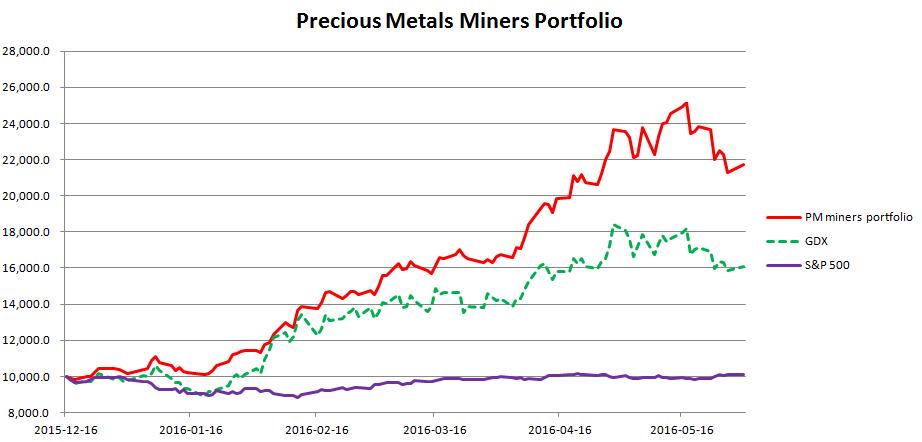


However, since inception (December 16, 2015) the Precious Metals Portfolio returned 117.3%:


As the chart shows, my picks returned 58.7 percentage points more than GDX (58.6% since December 16, 2016).

The chart below shows returns delivered by each pick, since inception:


Two stocks are the leaders: Newmarket Gold and Richmont Mines. It is no wonder - both companies own excellent properties, Fosterville (Newmarket) and Island Gold (Richmont). In the long-term the property is what counts.

Last but not least. Precious metals still perform much better than the broad stock market:


Summarizing - May was a bad month for the entire precious metals sector but in the medium-term these assets are still quite a nice proposal.

And the last chart - portfolio breakdown:


Thursday, June 2, 2016

Eric Sprott Is Also A Trader

A few weeks ago I posted a number of articles on the acquisitions made by Eric Sprott. Mr. Sprott is a notable resource investor - he invests in the long-term and his acqusitions are tracked by many investors. However, apart from being a long-term investor, Eric Sprott is a short-term trader as well. 
Let me show a few of his last transactions.

Excellon

Excellon shares went strongly up on the news that Eric Sprott made a substantial acquisition. To remind my readers - on April 4, 2016 Mr. Sprott acquired 6.67 million shares of Excellon (plus 3.33 million warrants) paying C$0.45 a share.

Then, between May 2 and May 20, he sold 0.6 million shares (a small part of his holdings) at prices ranging from C$1.32 to C$1.36 a share. In that way he made a nice profit of C$536 thousand in just a few weeks:


                                     source: www.stockcharts.com

Newmarket Gold

On April 4, 2016 Eric Sprott bought 10 million shares of Newmarket Gold at C$2.25 a share. On April 26 he bought additional 16.2 million shares paying C$2.80 a share. 

Then, between May 13 and May 18 he sold 455.3 thousand shares at C$3.97 a share, on average. Similarly to the Excellon deal, he made a quick profit of C$627 thousand:


                        source: www.stockcharts.com

Summary

In the above described transactions, Eric Sprott made a total profit of C$1,163 thousand in just a few weeks. 

I do not know why Mr. Sprott does it. Maybe he tries to time the market - when he sees that prices went too high and too fast he sells part of his investment to buy back at lower prices. We'll see. 

But looking at his transactions it looks like he is able to time the market in some way.


Monday, July 25, 2016

Fresnillo plc - Overvalued In The Short - Term

Fresnillo plc is the largest world’s silver producer. Most recently the company’s shares benefited from the current bull market in silver and since the beginning of 2016 they appreciated by 155%. 

In my opinion, it is quite a significant increase, especially when it is realized that Fresnillo is a giant miner. With its market capitalization of $17.6 billion, the company ranks among such heavyweights as Barrick ($23.9 billion), Newmont ($21.3 billion) or Goldcorp ($14.9 billion). Of these giants only Barrick appreciated more than Fresnillo – since the beginning of 2016 this company increased 169% in its market cap.

Is that outstanding share price increase justified? In my opinion, it is not. I like Fresnillo – the company is well – managed, profitable even during down-turns and has a few very interesting projects under development / construction. What is more – Fresnillo accounts for a large part of my model precious metals stocks portfolio (together with B2 Gold, Richmont Mines, Fortuna Silver and Newmarket Gold). So what is the problem?

Investment thesis

Well, in my opinion, in the short-term Fresnillo shares are currently overvalued against its peers. Additionally, Fresnillo's 1H 2016 results should be a kind of a negative surprise. Therefore, my investment thesis is:

“Do not buy these shares now”


1H 2016 results – my forecast

On July 20, 2016 the company announced its 1H 2016 production results:


As the table shows, the company increased its production substantially. Paradoxically, the lowest increase was in the silver segment. I say “paradoxically” because Fresnillo is perceived as a silver producer. 

However, it is no longer a case. In 2015 the company sold gold for $827 million while silver sales were just $617 million. What is more, even putting the San Julian mine on line (it will be a silver producing operation) should not change the company’s profile – gold is going to be the main metal delivered by Fresnillo.

Metals produced by the company were sold at the following gross prices (it is my estimate – the company did not disclose these prices):


And here is the first problem. As the table shows, apart from gold, all metals were sold at lower prices than in 1H 2015.

Another thing – Fresnillo sells mainly metal concentrates, which means that it is paid only for the so-called payable amounts of metals. What is more, the company has to pay smelting and refining charges to process its concentrates at smelters' facilities. Unfortunately, Fresnillo does not disclose the payable amounts of metals sold. However, I have calculated the average ratios between metals produced and sold over the years so, assuming that all metals produced in 1H 2016 were sold (here I may be wrong – such a reasoning is a little bit simplified), Fresnillo should have sold the following amounts of metals:


…and the company should have reported the following revenues:


Well, for the time being all things look nice – the total 1H 2016 revenue should be higher by 13.5% than that reported in 1H 2015.

Now, problems. Fresnillo did not disclose its costs of production. However, looking at the amount of ore processed, grades and recovery ratios reported at each mine, I assume that to produce one ounce of silver equivalent the company had to spend the same amount of money as in 2015 - $13.64 per ounce.

Note that this figure includes also treatment and refining charges.

If I am right, Fresnillo spent $803.2 million to produce its metals in 1H 2016 ($13.64 x 21.18 million ounces of silver sold divided by 36% (silver share in total revenue). So, due to higher amount of metals sold, in 1H 2016 Fresnillo incurred higher costs of production than in 1H 2015 ($665.1 million).

The table below presents the final forecast:


Note that the line “Silverstream and forex impact” contains the effects of the silverstream contract (signed in 2007 with Penoles) and a number of commodity (yes, Fresnillo is using hedging strategies to hedge itself against lower gold prices) and forex hedges. Due to these instruments, in 1H 2015 the company reported a negative result. According to the last production report, in 1H 2016 the losses should be even higher ($35.0 million against $13.8 million).  

Summary

As the table shows, 1H 2016 results should be weaker than those reported in 1H 2015. I think it may be a negative surprise for many investors. The mass mentality is that we are currently in a bull market phase in gold / silver and mining companies should report much better results than in the past. And they are generally right but…not so fast. In the case of Fresnillo, 1H 2016 was rather a disappointment but I am sure that the company is going to deliver much better results in the not so distant future.

So, in the short - term Fresnillo's shares are overvalued but in the long – term they still present a great buying opportunity.

Last but not least, if I am right, at today’s share prices the company is trading at 33.3 of its EV / EBITDA ratio. Really elevated valuation...